
Why Is the Bernina Train Red?
The crimson livery of Rhaetian Railway trains has become inseparable from the Swiss Alps in the public imagination. But this wasn't always the case—and the story behind the color choice reveals something about Swiss pragmatism and marketing genius.
When Rhaetian Railway launched in 1889, its first trains weren't red at all. Early locomotives and carriages wore various colors typical of the era: greens, browns, and blacks. The red livery emerged gradually through the early 20th century, becoming standardized across the fleet by the 1930s.
The Practical Origins
Why red? Several factors likely contributed:
- Visibility: A bright red train stands out against white snow, green forests, and grey rock—important for safety on mountain routes
- Swiss tradition: Red appears prominently in the Swiss flag and national identity
- Railway convention: Many European narrow-gauge railways adopted red or maroon liveries in the early 1900s
- Paint durability: Red oxide-based paints were known for weather resistance—crucial in Alpine conditions
The Branding Masterstroke
Whether intentional or accidental, the red livery became Rhaetian Railway's most powerful marketing asset. Against the Alpine backdrop, the red train creates an instantly recognizable image. Every photograph of a red train crossing the Landwasser Viaduct or circling the Brusio loop serves as free advertising for Swiss tourism.
Today, the red color is carefully maintained across all RhB trains. Even modern panoramic coaches introduced in the 2000s and 2010s continue the tradition. It's become so iconic that changing it would be unthinkable.
🎨 Color Specifications
Rhaetian Railway uses a specific red formulated for their fleet. While exact specifications aren't public, it's similar to RAL 3000 (Flame Red) or RAL 3020 (Traffic Red). The shade has remained remarkably consistent across decades of rolling stock.
The Red Train on the Bernina Line
While all Rhaetian Railway trains share the red livery, the Bernina Express has become synonymous with "the red train" in tourist parlance. This makes sense: the Bernina line offers the most photogenic combination of red train and dramatic scenery.
Why the Bernina Line Is Special
Other RhB routes traverse beautiful terrain, but the Bernina line offers unique advantages for the red train's visual impact:
- Open-air running: Unlike the tunnel-heavy Albula line, the Bernina stretch features long exposed sections where the train is fully visible
- Contrast landscapes: Glaciers, alpine lakes, green valleys, and stone viaducts provide varying backdrops
- Engineered photo opportunities: The Brusio Circular Viaduct seems designed for photography, with the red train spiraling through 360 degrees
- Border crossing: The train connects Switzerland to Italy, adding international cachet
Photographing the Red Train
Capturing the perfect red train photograph requires planning. Here are the best locations and techniques based on my own shoots along the line:
Landwasser Viaduct (Near Filisur)
The most famous spot. The 65-meter-high curved viaduct emerges from a tunnel into a cliff face. However, you can't photograph the train while riding it—you need to be outside.
How to shoot it:
- Take a regional train to Filisur and walk to the designated viewpoint (20 minutes)
- Best light: Morning sun illuminates the viaduct from the east
- Check the timetable for train passages—both regular and Bernina Express trains pass regularly
- A 70-200mm lens frames the viaduct nicely from the viewpoint
Brusio Circular Viaduct
The 360-degree spiral viaduct near Tirano. The train completes a full circle, giving you multiple angles as it passes.
How to shoot it:
- Walk from Brusio station to the viaduct (15 minutes)
- Position yourself on the hillside above for an elevated view
- Use a wide-angle lens to capture the full spiral
- Afternoon light works best for front-lit trains heading south
Morteratsch Glacier Area
The red train against white glacier—a classic contrast. The Morteratsch station area offers several angles.
How to shoot it:
- The glacier viewpoint trail provides elevated positions
- Use a telephoto lens to compress the train against the glacier background
- Morning light avoids harsh shadows on the mountains
Lago Bianco (Ospizio Bernina)
The red train crossing the dam with the milky blue lake in frame. Stunning in both summer and winter.
How to shoot it:
- Walk along the lake from Ospizio Bernina station
- Dawn and dusk offer reflections if the water is calm
- In winter, the frozen lake creates a monochrome backdrop that makes the red train pop
📸 Photography Tips
Use a shutter speed of 1/500s or faster to freeze the moving train. The red color can confuse auto white balance—shoot RAW to correct in post. Don't forget to actually enjoy the view between shots.
The Red Train in Winter
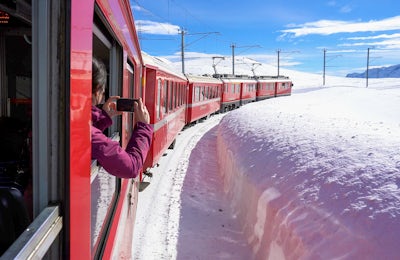
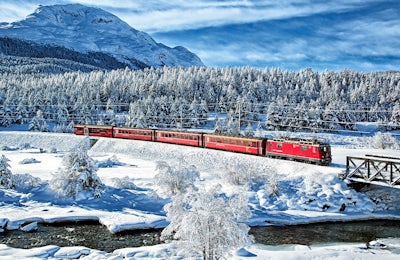
Winter transforms the red train into something almost magical. Against snow-covered mountains and frozen lakes, the crimson carriages create a Christmas-card image that draws photographers from around the world.
Why Winter Photography Works
- Maximum contrast: Red against white is as high-contrast as you can get
- Clean backgrounds: Snow hides visual clutter like power lines and parking lots
- Low sun angles: Winter light stays golden throughout the short day
- Fewer crowds: You'll share viewpoints with fewer tourists
Winter Challenges
- Short daylight: Plan around the 8am-5pm window
- Cold batteries: Keep spares warm in your pocket
- Access: Some viewpoint trails may be snow-covered or closed
- Weather: Clouds and snowfall can obscure views for days
Other Rhaetian Railway Routes
The red train operates across the entire Rhaetian Railway network, not just the Bernina line. Other scenic red train routes include:
The Albula Line (Chur – St. Moritz)
Part of the same UNESCO designation as the Bernina line. Features the Landwasser Viaduct and famous spiral tunnels. More tunnels mean fewer continuous photo opportunities, but the engineering is spectacular.
The Arosa Line
A branch line climbing from Chur to the resort of Arosa. The Langwieser Viaduct (the highest in Europe when built) offers dramatic photo angles.
The Davos – Filisur Line
Connects the Albula line to Davos, passing through the Wiesen Viaduct—another impressive stone arch bridge.
Red Train vs. Glacier Express
Visitors often confuse the two famous Swiss trains. Here's the difference:
| Feature | Bernina Express (Red Train) | Glacier Express |
|---|---|---|
| Operator | Rhaetian Railway (RhB) | RhB + Matterhorn Gotthard Bahn |
| Route | Chur – Tirano (Italy) | St. Moritz – Zermatt |
| Duration | ~4 hours | ~8 hours |
| Train Color | Red (RhB livery) | Red (both operators) |
| Highest Point | 2,253m (Ospizio Bernina) | 2,033m (Oberalp Pass) |
| Crosses into Italy | ✓ Yes | ✗ No |
Both trains are red, both traverse spectacular Alpine scenery, and both offer panoramic cars. The Bernina Express is shorter and crosses into Italy; the Glacier Express is longer and connects two major Swiss resorts.
The Future of the Red Train
Rhaetian Railway continues investing in new rolling stock while maintaining the iconic red livery. Recent additions include:
- Modern panoramic coaches: Introduced in 2006 and updated since, featuring larger windows and improved comfort
- Allegra multiple units: Newer electric trains that maintain the red color scheme
- Historic preservation: Older locomotives and carriages are maintained for special charter services
The red train will remain red for the foreseeable future. It's not just a color—it's become part of Switzerland's national identity.
Riding the Red Train: Practical Information
Ready to experience the red train yourself?
- Tickets: Book the Bernina Express for panoramic cars, or ride regular red RhB trains on the same route
- Best sections: St. Moritz to Tirano offers the most open-air red train scenery
- Photography stops: Consider breaking the journey at Filisur or Brusio for exterior shots
- Season: Each season offers different red-train-versus-landscape contrasts