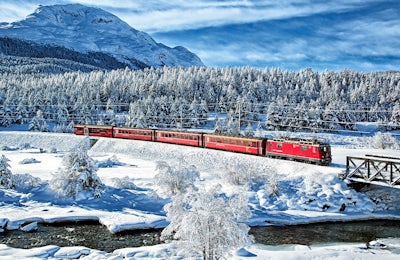
Understanding the Two Lines
The Bernina Express isn't one railway—it's two distinct lines stitched together at St. Moritz. Understanding this helps you appreciate the journey's engineering achievements and plan your viewing strategy.
The Albula Line (Chur – St. Moritz)
Built between 1898 and 1904, the Albula Line climbs from Chur (585m) to St. Moritz (1,775m) through a series of engineering marvels that still astound railway experts. The line gains nearly 1,200 meters of altitude without using cog railways—pure adhesion traction on regular rails.
Key engineering features:
- Spiral tunnels: The train loops inside mountains to gain altitude, sometimes crossing the same valley at three different levels
- The Landwasser Viaduct: A 65-meter-high curved bridge that exits directly into a tunnel—Switzerland's most photographed railway structure
- Gradient: Maximum 3.5%, achieved through ingenious route planning
The Bernina Line (St. Moritz – Tirano)
Opened in 1910, the Bernina Line takes a different approach. It climbs even higher—to 2,253m at Ospizio Bernina—then plunges down to the Italian town of Tirano at 429m. This is the steepest adhesion railway in the Alps, with gradients up to 7%.
What makes it special:
- Open-air section: Unlike the Albula Line's many tunnels, the Bernina stretch offers continuous panoramic views
- Glacier proximity: The train passes within sight of the Morteratsch and Palü glaciers
- The Brusio Circular Viaduct: A 360-degree spiral on an open stone bridge—engineering as art
📍 Route Note
Most tourists ride only the Bernina Line (St. Moritz – Tirano) as it offers more consistently open views. The full Chur – Tirano route adds the Albula Line's tunnel-heavy but historically significant section.
Station-by-Station Guide
Here's what you'll experience at each major stop along the route, traveling south from Chur to Tirano. I've included the camera-ready moments so you're not caught off guard.
Switzerland's Oldest City
The journey begins in Chur, a 5,000-year-old settlement nestled in the Rhine Valley. If you arrive early, the Old Town's car-free lanes and Roman-era archaeology merit a morning stroll. The Bernina Express departs from the main station, easily accessible from Zürich (1h15m) or other Swiss cities.
Camera moment: The departure offers views of the Rhine Valley and the first glimpses of the mountains you'll soon be climbing.
Gateway to the Gorges
After crossing the Rhine, the train reaches Thusis, historically the last major town before the Via Mala—a notorious gorge that challenged travelers for centuries. The railway bypasses the gorge's worst sections through tunnels, but you'll catch glimpses of the dramatic rock walls.
First Spiral Tunnel
Here the serious climbing begins. The train enters the first of several spiral tunnels, emerging at a higher altitude with views back down to the valley floor. Watch for the Solis Viaduct—at 89 meters, it was once the world's highest stone railway bridge.
The Landwasser Viaduct Approach
Shortly after Filisur comes the journey's most iconic moment: the Landwasser Viaduct. The train crosses a 65-meter-high curved stone bridge with six arches, then plunges directly into a tunnel carved into the cliff face. The structure appears on countless Swiss postcards for good reason.
Camera strategy: You can't photograph the viaduct while crossing it—you're on it. The best views come from looking backward immediately after entering the tunnel (left side if heading south) or from the observation platform at Filisur station if you break your journey.
The Spiral Tunnel Showcase
This seven-kilometer section contains the Albula Line's most ingenious engineering. The train climbs 416 meters through a series of helical and spiral tunnels. You'll see Bergün village from three different elevations as the train loops through the mountain.
Pro tip: Children often lose interest here since much of this section is inside tunnels. Have entertainment ready.
Alpine Resort Junction
The famous resort town marks the junction between the Albula and Bernina lines. Some travelers break their journey here—the town offers world-class skiing, upscale shopping, and lakeside walks. The Bernina Express typically stops for a few minutes, allowing passengers to stretch their legs.
From St. Moritz, the character of the journey changes. The Bernina Line heads south with fewer tunnels and more sustained panoramic views.
Mountaineering Village
A quieter alternative to glitzy St. Moritz, Pontresina serves as a base for serious mountaineers and hikers. The Roseg Valley, accessible from here, offers some of the region's best glacier hiking.
Glacier Views Begin
The Morteratsch Glacier comes into view on the right side (heading south). Marker posts along the valley floor show how far the glacier has retreated since 1900—a sobering visualization of climate change. On clear days, Piz Bernina (4,049m), the highest peak in the Eastern Alps, dominates the skyline.
Camera moment: The glacier and Piz Bernina are best captured from this section. Have your camera ready on the right side.
Glacier Access Point
A cable car from this station ascends to the Diavolezza viewing platform (2,973m), offering close-up views of the Piz Palü and Piz Bernina. If you're breaking your journey, this is one of the most rewarding stops for mountain scenery.
The Summit
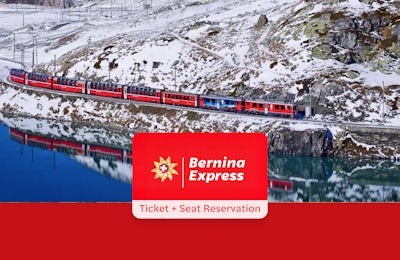
This is the highest point on the journey and the highest railway station in the Alps accessible without a cog railway. The milky turquoise Lago Bianco (White Lake) stretches beside the tracks—its color comes from glacial sediment suspended in the water.
At this altitude, even summer days can be cold. The watershed here divides waters flowing to the Black Sea (via the Danube) from those reaching the Adriatic Sea (via the Po).
Camera moment: Lago Bianco offers stunning reflections in calm weather. Both sides of the train provide good views.
Terrace with a View
The train pauses at Alp Grüm, a station famous for its restaurant terrace overlooking the Palü Glacier and Lago Palü. Even if you don't stop, the views from the train here rank among the journey's finest.
From this point, the descent accelerates. The train drops 1,600 meters over the next 30 kilometers to reach Tirano.
Italian-Speaking Switzerland
You're still in Switzerland, but the language shifts to Italian. Poschiavo's town center features colorful Renaissance-era buildings and a relaxed Mediterranean atmosphere. The valley's microclimate supports chestnut groves and small vineyards—a stark contrast to the glaciers an hour behind you.
The Circular Viaduct
The route's final engineering marvel: a 360-degree spiral viaduct in the open air. The train completes a full circle on this nine-arch stone bridge, losing altitude while providing views in every direction. It's the perfect finale before crossing into Italy.
Camera moment: Best viewed from the left side (heading south). You'll see the full curve of the viaduct ahead before the train turns onto it.
Italian Terminus
The journey ends in the Italian town of Tirano, where palm trees and espresso bars replace Alpine chalets. The station sits near the center of town, a short walk from the Sanctuary of Madonna di Tirano, a 16th-century pilgrimage church.
From Tirano, you can connect to the Bernina Express Bus to Lugano, catch Italian trains toward Milan, or simply enjoy the town's surprisingly excellent restaurants.
Which Direction Should You Travel?
Both directions offer identical scenery, but the experience differs:
Chur/St. Moritz → Tirano (Southbound)
- Morning departures catch the best light on glaciers and viaducts
- You end in Italy—convenient if continuing to Milan or Lake Como
- The dramatic altitude loss feels like descending from a different world
- More popular direction, so trains may be more crowded
Tirano → St. Moritz/Chur (Northbound)
- Afternoon departures can catch golden hour light on the upper sections
- You end in Switzerland—convenient for Zürich or other Swiss destinations
- The climb feels more dramatic as you ascend to the Bernina Pass
- Often slightly less crowded than southbound trains
💡 Expert Recommendation
For first-time visitors with flexibility, I suggest the southbound morning departure from St. Moritz. The light is optimal for photography, and ending in Tirano gives you the option of a leisurely Italian lunch before returning or continuing south.
Seasonal Route Differences
The route operates year-round, but conditions vary significantly:
Summer (May – October)
- Longest operating hours with multiple daily departures
- Wildflowers in alpine meadows (June-July peak)
- Glaciers visible but retreating—clear views of moraines
- Bernina Express Bus connects Tirano to Lugano
- Highest crowds, especially July-August
Autumn (September – October)
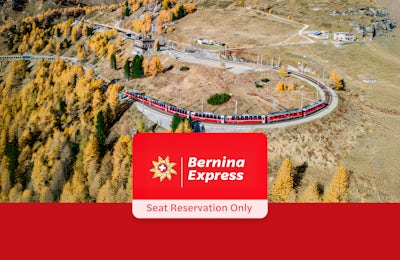
- Larches turn golden in the Engadin Valley
- Thinner crowds, especially after mid-September
- Clear skies common, excellent visibility
- Photographers' favorite season
Winter (November – April)
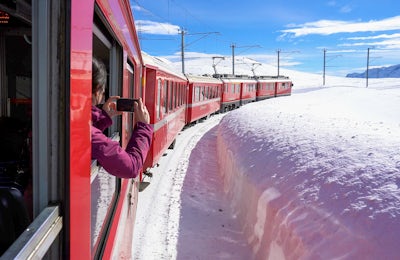
- Snow-covered landscapes create a different beauty
- Lago Bianco freezes over
- Fewer departures; check winter timetable
- Bernina Express Bus does not operate
- Some high-altitude attractions (cable cars) may be closed
⚠️ 2026 Route Diversion
Due to engineering works, Bernina Express trains will be diverted via Vereina from October 29 to November 13, 2026. The Albula section (including the Landwasser Viaduct) will be bypassed during this period. Check official sources when booking.
Breaking the Journey
You don't have to travel the entire route in one go. Here are the best places to stop:
For Landwasser Viaduct Photography
Filisur – A viewing platform near the station offers the classic postcard angle. You can catch a later train to continue.
For Glacier Hiking
Morteratsch – A well-marked trail leads to the glacier snout (2 hours round trip). Combine with a later train departure.
For Alpine Panoramas
Diavolezza – Take the cable car to 2,973m for Piz Bernina views. Allow 2-3 hours for the round trip.
For a Meal with Views
Alp Grüm – The restaurant terrace overlooks the Palü Glacier. No road access—only reachable by train.
For Italian Culture
Poschiavo – Explore the Italian-speaking Swiss town, enjoy local cuisine, then catch a later train to Tirano.
Photography Guide by Section
Here's a quick reference for where to position yourself:
| Highlight | Best Side (Southbound) | Notes |
|---|---|---|
| Landwasser Viaduct | Look backward after crossing | You're on the bridge—can't photograph while crossing |
| Morteratsch Glacier | Right side | Best views for 10-15 minutes |
| Piz Bernina | Right side | Clear weather essential |
| Lago Bianco | Both sides | Lake surrounds the track |
| Palü Glacier | Right side | Best from Alp Grüm area |
| Brusio Viaduct | Left side | See the curve ahead before entering |
📸 Camera Settings
Use a fast shutter speed (1/500s or faster) to compensate for train movement. The panoramic windows can create reflections—wear dark clothing and cup your hand around the lens when shooting.
Connecting Routes
The Bernina Express integrates with other Swiss scenic routes:
- Glacier Express: Shares the Chur–St. Moritz section; continues to Zermatt via Andermatt
- Bernina Express Bus: Connects Tirano to Lugano (summer only), completing a circle route through the Alps
- Gotthard Bernina Round Trip: Combines Bernina Express with the Gotthard route for a circular journey